Featured image via Sony Pictures.
It was summer 1999 when my dad brought a 9 year-old me to the movies to see the latest feature-length production from Jim Henson Studios, Muppets From Space. As was (and still is) tradition, my dad and I got a bucket of popcorn along with sodas that require two hands to carry and sat towards the back of the stadium-style theater.
The cinema also happened to be showing Summer of Sam, a crime thriller from auteur director Spike Lee. At the time, however, I believed it to be a slasher film about the serial killer mentioned in that one episode of Seinfeld where George thinks someone is saying “Son of Sam” instead of “Seinfeld’s van”. As a scaredy-cat kid who prided herself on missing the last two Halloweens by going to Disney World instead, it was not a movie I wanted to walk in on. (On a side note, while doing my bit of research to confirm what had been lingering in my memory for 25 years, I discovered that it’s the one film between the two actually distributed by Disney (Buena Vista Pictures.))
Parallel to my wuss-like tendencies, I was – and still am – very much an indoor kid. Hours outside of school were spent writing, playing Carmen Sandiego games, and, of course, watching hours and hours of the Disney Channel and Nickelodeon. Anything involving running or being athletic in any way felt like a chore to me, perhaps due to the lack of thought and creativity that went into hide-and-seek or tag. (But mostly, I just really sucked at it.) As a then-undiagnosed autistic person, the complicated web of playground politics was simply too overwhelming, and often led to ostracization if I made any sort of social misstep I wasn’t aware of. And while I was always strongly encouraged by teachers to focus on my creative talents and keep writing, the adult authority figures still seemed to have this hang-up about going outside and talking to other kids. For all intents and purposes, I was a well-behaved kid, even if that behavior was discouraged from time to time.
Which is likely why the following experience has stuck in my mind all these years. As the ads and the movie trivia slowly faded in and out on the screen, a small group of what I would assume were either older teenagers or 20-somethings entered the theater. While they weren’t necessarily being loud or obnoxious, their presence and their giddiness raised my suspicions. What were a bunch of cool, older kids doing seeing a Muppet movie? And not only that, why did they seem… excited? Weren’t they too old to care about Gonzo’s extraterrestrial origins? Their behavior briefly reminded me of those evil boys with pillowcases and ghostface masks dashing erratically from house to house during trick-or-treat – the very kids I was happy to leave behind for the Disney-MGM Studios Backlot Tour and Mickey’s Not-So-Scary Halloween Party.
For a moment, I figured we must have been in the wrong theater. In my nine years of life experience, I had determined that there was just no way anyone above age 12 would be psyched to see a Muppet movie.
“Are you sure we’re in the right theater, and not Summer of Sam?” I asked my dad.
“Nope, we’re in the right theater,” he replied confidently, while fully aware of the exact source of my doubts. I think I even asked him to go check the sign by the theater entrance, just to make sure. Yep, we were about to watch Muppets From Space, despite the possibly stoned and/or tipsy college students near the front row.
I remained anxious throughout the last few minutes of the ads and movie trailers, intermittently glancing back down on the group below for any clues that we could be in the wrong theater. To my relief, Kermit popped out from behind a crane camera and shot me a quick chuckle, almost as if he had set it up all along. What a stinker.
Little did I know, in those moments before the most accidentally well-timed production logo I ever experienced, I was essentially gazing down at my future: an adult stoked for new Muppet content. What I knew even less, was that I was about to witness one of the most heart wrenching images in cinema history – for myself and anyone else who has never quite fit in.
For those who are not familiar or perhaps haven’t seen it since renting it from Blockbuster for a sleepover, Muppets From Space (1999) attempts to definitively answer the questions: what exactly is Gonzo and where does he come from?
The story opens on what could have potentially been a snippet of the Muppet Old Testament. As the storm rages and the floods begin to rise, the biblical Noah (F. Murray Abraham) stands at the entrance to his ark as each pair of creatures goes up the ramp and into the safety of the vessel. But when Gonzo arrives without a partner, a suddenly cold-hearted Noah turns him away, as Gonzo is unable to identify his own species. As the poor “whatever” is left on his own to drown, he throws his head back and shouts repeatedly to the sky, “No! No, no, no! I don’t want to be alone!” The camera points down at him as it dramatically pans upwards and outwards, thunder snapping and booming around his soon-to-be watery grave.
Luckily, in pure cinematic fashion, Gonzo wakes up to reveal it had all been just a bad dream. What follows is an iconic morning routine sequence at the Muppet boarding house where he resides, establishing the Normal World and the film’s funkadelic motifs to the tune of “Brick House” by Commodores. The nightmare, however, causes Gonzo to wonder lamentably why he is the only one of his kind on Earth, provoking questions of his true origins.
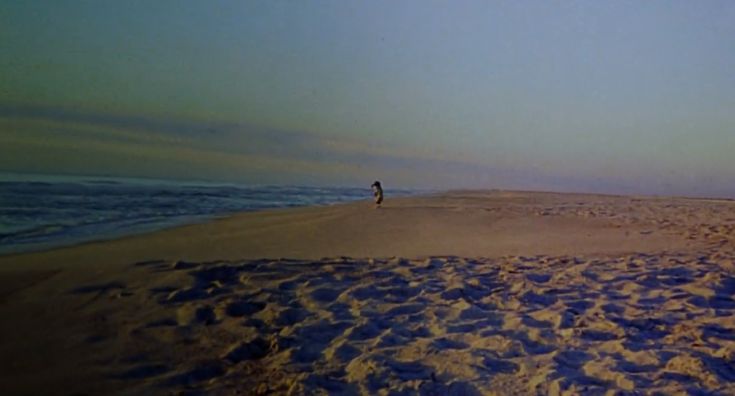
This brings us to the aforementioned heart wrenching image. To illustrate his loneliness, Gonzo has a look at the family portraits that line the hallway of the boarding house. The camera pans across each Muppet and their respective relatives: Fozzie with his mother. Miss Piggy with her fellow pigs. Kermit with his nephew Robin. And then there’s a snapshot of Gonzo, taken from far away – a mere speck in the middle of the beach, contemplating the unknowable vastness of the ocean that lay before him.
Aside from being a hilarious and somewhat ridiculous concept, Muppets going through existential crises is something that hits on two different levels. One, the surface level: the general awareness of both what is being elicited and the fact that this message is coming from the Muppets. This is the part that tends to be taken a little less seriously, as it’s being told in the form of goofy, bulb-eyed puppets with hands up their asses. The second level hits right in the feels – perhaps the way it was intended. It connected with the actual child or, the inner child of the adult watching. When these two levels clash, it produces the healing sentiment that has drawn viewers to Jim Henson’s characters for decades. All this to say, that photo captures the beauty and essence of the Muppets, right there. Something that is both side-splittingly absurd yet tenderly poignant all at once. Speaking simultaneously to the adult, and the child within.
I think many people – especially self-proclaimed misfits – can see themselves in that portrait of Gonzo. Certainly I felt the pang of loneliness seeing that shot for the first time on the big screen. Looking back, I can insert my own childhood self into the beach scene. Only it would likely be 4th grade me dissociating during a playground game of Foursquare, wishing everyday were cold or rainy enough for indoor recess so that I could stay inside and write for 20 minutes instead. Or 5 year-old me running back home after trick-or-treating at only a few houses on my cul-de-sac because the older kids and their scary costumes were starting to come out.
Which brings me back to the older “kids” in the movie theater. I had found it strange that people of that age were going to see a Muppet movie in theaters without accompanying children – to the point that I doubted my own justification for being in the same room.
Not to necessarily blame myself for having judged these total strangers, (let’s remember, I was 9 and operating on my limited understanding of the world as such,) but later on – decades, even – it would occur to me that those people witnessed the same thing I witnessed on screen that very July afternoon. Could it be… the adults… paying money to go see a Muppet movie with… other adults, in a time and culture where they were more likely the target age demographic for, say, a crime thriller starring John Leguizamo and Adrien Brody… also saw themselves in that very same photograph of Gonzo on the beach?
On the other hand, they could’ve just been toasted to high heaven and figured a Muppet movie set to funk music was a great way to kill some free time before classes started up again. Either way, they didn’t fit into my idea of what adults or people older than me should be doing in their off time, just as I never quite fit into what some adults thought I should be doing with my free time.
At the risk of spoiling a family movie released in 1999, Gonzo does eventually make contact with his family of origin, who happen to be a musically talented alien species. Although their reunion culminates in a funkadelic beach concert courtesy of Gonzo’s space brethren, Gonzo ultimately decides to stay on planet Earth with his chosen family: the Muppets.
So after becoming an adult and continuing my long-held tradition of staying inside to write and avoid sports – as well as remaining an avid Muppet fan – I find I’ve managed to come full circle in my understanding of this random group of strangers I shared a theater with over a quarter of a century ago. Again, not to project my own assumptions onto these people, for those 87 minutes – even during the 2nd lowest-rated Muppet movie of all time, according to Rotten Tomatoes – everyone in that theater was confronted with that image of Gonzo. Whether it caused us to laugh, cry, or stare in weed-induced awe, we all shared arguably one of the few redeeming aspects of Muppets From Space.
*Cue the Jim Henson production company logo*


 Souvenir Mug
Leave a comment